
Table of Contents
- What Are Research Peptides?
- High Purity Research Peptides: Quick Comparison Table
- How to Evaluate Peptide Purity Analysis Certificates
- Peptide Storage and Stability Best Practices
- Legality of Research Chemicals in the UK
- Quality Assurance and Third-Party Testing
- Why Purity Matters for Your Research
- Making Your Purchase Decision
- Frequently Asked Questions
Last Updated: September 30, 2026
What Are Research Peptides?
Research peptides are short chains of amino acids synthesised for laboratory investigation rather than human consumption. They're used across academic institutions, biotechnology firms, and contract research organisations to study metabolic pathways, regenerative processes, and cellular mechanisms.
Research-grade peptides must come with batch-specific verification of composition through high-performance liquid chromatography (HPLC) and mass spectrometry analysis, ensuring consistent, reproducible results.
Titan Forge Compounds supplies high purity research peptides as lyophilised (freeze-dried) powders with batch-specific documentation. This standardisation prevents contamination from derailing research.
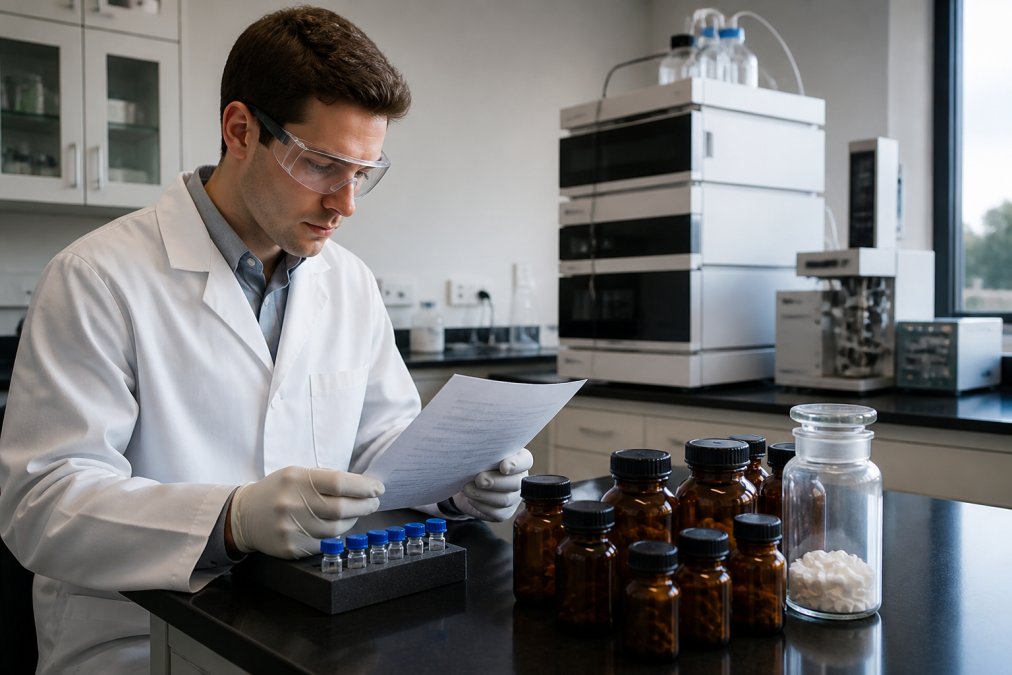
High Purity Research Peptides: Quick Comparison Table
| Peptide | Contents | Form | Starting Price | Best For |
|---|---|---|---|---|
| MOTS-c 10mg | 16-amino-acid mitochondrial peptide | Lyophilised powder | £18.99 | Metabolic pathway studies |
| BPC-157 10mg | 15-amino-acid synthetic peptide | Lyophilised powder | £22.99 | Regenerative research |
| TB-500 10mg | Thymosin beta-4 fragment | Lyophilised powder | £27.99 | Tissue repair investigations |
| CP10 Blend | 5mg CJC-1295 + 5mg Ipamorelin | Lyophilised powder | £29.99 | Combined mechanism studies |
| GHK-Cu 100mg | Copper-peptide complex (tripeptide) | Lyophilised powder | £29.99 | Collagen synthesis research |
| Ipamorelin 10mg | 5-amino-acid synthetic peptide | Lyophilised powder | £35.00 | Growth hormone pathway studies |
| Retatrutide 15mg | Investigational synthetic peptide | Lyophilised powder | £49.99 | Advanced metabolic research |
| Tesamorelin 10mg | GHRH analogue | Lyophilised powder | £59.99 | Hormone secretion studies |
How to Evaluate Peptide Purity Analysis Certificates
A Certificate of Analysis (COA) is your proof that a peptide meets its advertised specification. It should contain batch-specific data, not generic templates. Learning to read and interpret the technical data separates legitimate suppliers from those using documentation as marketing theatre.

What a Complete COA Must Contain
A batch-specific COA should include:
- Batch or Lot Number: A unique identifier for that production run, allowing traceability to synthesis date and manufacturing conditions. Generic COAs shared across multiple batches are a red flag.
- Testing Date: When the analysis was performed. A COA dated more than one year before delivery warrants clarification from the supplier.
- Peptide Name and Sequence: The exact amino acid sequence (e.g., MOTS-c as a 16-amino-acid mitochondrial peptide). This confirms you're receiving the correct compound, not a similar-sounding alternative.
- Molecular Weight (MW): Expressed in Daltons (Da). For example, BPC-157 has a molecular weight of approximately 1,502 Da. This number is critical; it's confirmed by mass spectrometry and proves the peptide is structurally intact.
- Purity Percentage: Typically expressed as a range (e.g., 95-99%). A purity claim without HPLC documentation is unverified.
- Testing Methods: Which analytical techniques were used. HPLC (high-performance liquid chromatography) and MS (mass spectrometry) are the standards. If only one method is listed, ask why the other wasn't performed.
- Third-Party Laboratory Name: The independent lab that performed the analysis. Reputable suppliers disclose this; it allows you to verify the laboratory's credentials and accreditations independently.
Reading HPLC Data on a COA
HPLC separates the peptide from contaminants and quantifies each component. The purity percentage is calculated from the area under each peak. A legitimate HPLC report identifies what each impurity peak represents, synthesis byproducts, oxidised variants, aggregates, or residual solvents, not just a total purity percentage. If a COA says "97% purity" without explaining the 3% impurity, you're missing critical information.
Reading Mass Spectrometry Data on a COA
Mass spectrometry measures molecular weight to confirm structural integrity. A difference of ±0.2 Da between observed and theoretical MW is acceptable; larger discrepancies suggest degradation or incorrect synthesis. If HPLC shows 97% purity but MS detects multiple molecular weight peaks, impurities include structural variants of the peptide, which may affect assay results unpredictably.
Identifying Red Flags in COA Documentation
Red flags include: undated or recycled certificates; missing MS data; vague impurity identification; no batch number or traceability; shared certificates across multiple batches; in-house testing by the supplier rather than third-party laboratories. Insist on batch-specific, third-party-tested COAs.
Request the COA before purchasing. Once received, verify the peptide name and sequence match your order, check the batch number on the vial against the COA, confirm purity meets your requirements, and verify the testing date is recent (within 3-6 months). Identify the third-party laboratory and verify its accreditation if possible. A supplier that becomes defensive about technical questions is signalling they don't stand behind their documentation.
Peptide Storage and Stability Best Practices
Peptides degrade through hydrolysis, oxidation, and deamidation at rates dependent on temperature. Room temperature storage (20-25°C) causes 5-10% potency loss per month; refrigeration (2-8°C) causes 1-2% per month; freezing (−20°C or below) causes less than 0.5% per month. A peptide at 98% purity stored at room temperature for six months may degrade to 94-95%, rendering it unsuitable for assays requiring 96% minimum purity.
UV and ambient light trigger oxidation in peptides containing methionine, tryptophan, or tyrosine residues, altering structure and biological activity. Store peptides away from direct sunlight and fluorescent lighting. Keep vials in a dark cabinet or opaque storage box, even during short-term refrigeration.
Lyophilised peptides are freeze-dried to remove water, the primary driver of hydrolytic degradation. Recap vials immediately after removing material. In humid environments, use a desiccant storage box with silica gel packets to prevent moisture absorption.
Reconstituted peptides in aqueous solutions remain stable for 24-48 hours at room temperature; in DMSO, 7-14 days at room temperature or several weeks if refrigerated. PBS buffers pH but offers no antimicrobial protection; DMSO is bacteriostatic but may interfere with assays. For timelines spanning weeks or months, freeze solutions at −20°C or −80°C. Thaw only the volume needed for each experiment; repeated freeze-thaw cycles degrade peptides.
Most research peptides remain stable in the pH range of 4-8. Extreme pH (below 3 or above 9) accelerates hydrolysis and aggregation. Verify buffer pH before use.
Peptides degrade during shipping if exposed to temperature fluctuation. Reputable suppliers use insulated packaging with ice packs to maintain cool temperatures. Upon arrival, transfer vials immediately to appropriate storage; the first few hours after delivery are critical.
Store unopened vials at 2-8°C in a dark refrigerator, or −20°C for long-term storage beyond six months. Store reconstituted solutions at −20°C or below in sealed, opaque containers. Label all vials with receipt/reconstitution date, peptide name, batch number, and initial purity percentage.
Legality of Research Chemicals in the UK
Research peptides supplied for laboratory use are legal to purchase and possess in the UK when intended for scientific investigation. Legality depends entirely on intended use; a peptide labelled "for laboratory research use only" must remain in the laboratory setting. Any suggestion of human consumption, veterinary application, or medical treatment moves the compound into regulated pharmaceutical territory. Procurement officers should verify that their institution's ethics committee has reviewed peptide sourcing practices. Consult your institution's research ethics committee or legal team if uncertain whether your intended research falls within legal bounds.
Quality Assurance and Third-Party Testing
Third-party testing is the only reliable way to verify that a peptide meets its specification. When a supplier tests its own products in-house, there's an inherent conflict of interest, they profit from declaring everything acceptable. Independent laboratories have no stake in the outcome and follow standardised analytical protocols.
HPLC-verified testing measures purity by separating the peptide from contaminants and quantifying each component.
Why Purity Matters for Your Research
A single impurity at 5% concentration can shift your results dramatically. If you're studying a peptide's effect on cell growth, a 5% contaminant might have its own biological activity, or might inhibit the intended peptide's activity. Your results become uninterpretable: you won't know whether you're measuring the peptide you ordered or the impurity alongside it.
Making Your Purchase Decision
Start by defining your experimental requirements. What amino acid sequence do you need? What purity threshold is acceptable for your assay? Will you need custom synthesis, or does an off-the-shelf research peptide meet your needs? These answers narrow your options immediately.
Frequently Asked Questions
How do I verify that high purity research peptides meet the stated purity percentage?
Request a batch-specific Certificate of Analysis (COA) that documents HPLC-verified purity and mass spectrometry results. The COA should identify the exact batch number, purity percentage, and analytical testing date. Third-party testing by independent laboratories provides additional assurance. Cross-reference the batch number on your vial with the COA to confirm traceability. Reputable suppliers provide COAs before purchase or immediately upon delivery.
What is the legal status of purchasing research peptides in the UK?
Research peptides are legal to purchase for laboratory use in the UK when supplied explicitly for scientific research purposes only. Suppliers must clearly label products 'For Laboratory Research Use Only' and not for human or veterinary consumption. Always verify that your institution's research ethics committee approves your intended use.
Is 98% purity the industry standard for research-grade peptides?
High-purity research peptides typically range from 95% to 99% purity, depending on the peptide type and analytical method. 98% purity is common for most applications, but some metabolic studies and regenerative research require 99% or higher. Check your experimental design requirements before purchasing. The purity percentage directly affects bioavailability and reproducibility, so verify that your chosen peptide meets your protocol's specifications.
What should I look for when choosing a peptide supplier?
Prioritise suppliers offering batch-specific Certificates of Analysis with HPLC and mass spectrometry verification. Confirm they provide lyophilised powder in sealed vials with clear storage instructions. Check for responsive customer support, secure, tamper-evident packaging, and documented traceability. Fast UK dispatch and free delivery on larger orders reduce research timelines and procurement costs.
Sourcing high purity research peptides requires attention to documentation, purity verification, and supplier reliability. Titan Forge Compounds provides batch-specific Certificates of Analysis, HPLC-verified purity, and fast UK dispatch to ensure your research compounds arrive intact and verified. Get started with Titan Forge Compounds' peptide collection and access the laboratory-grade standards your research depends on.